- Things Hidden
- Posts
- Things Hidden Christmas Special
Things Hidden Christmas Special
A Rational Look At The Christmas Miracle

Travis Kling
December 18, 2025
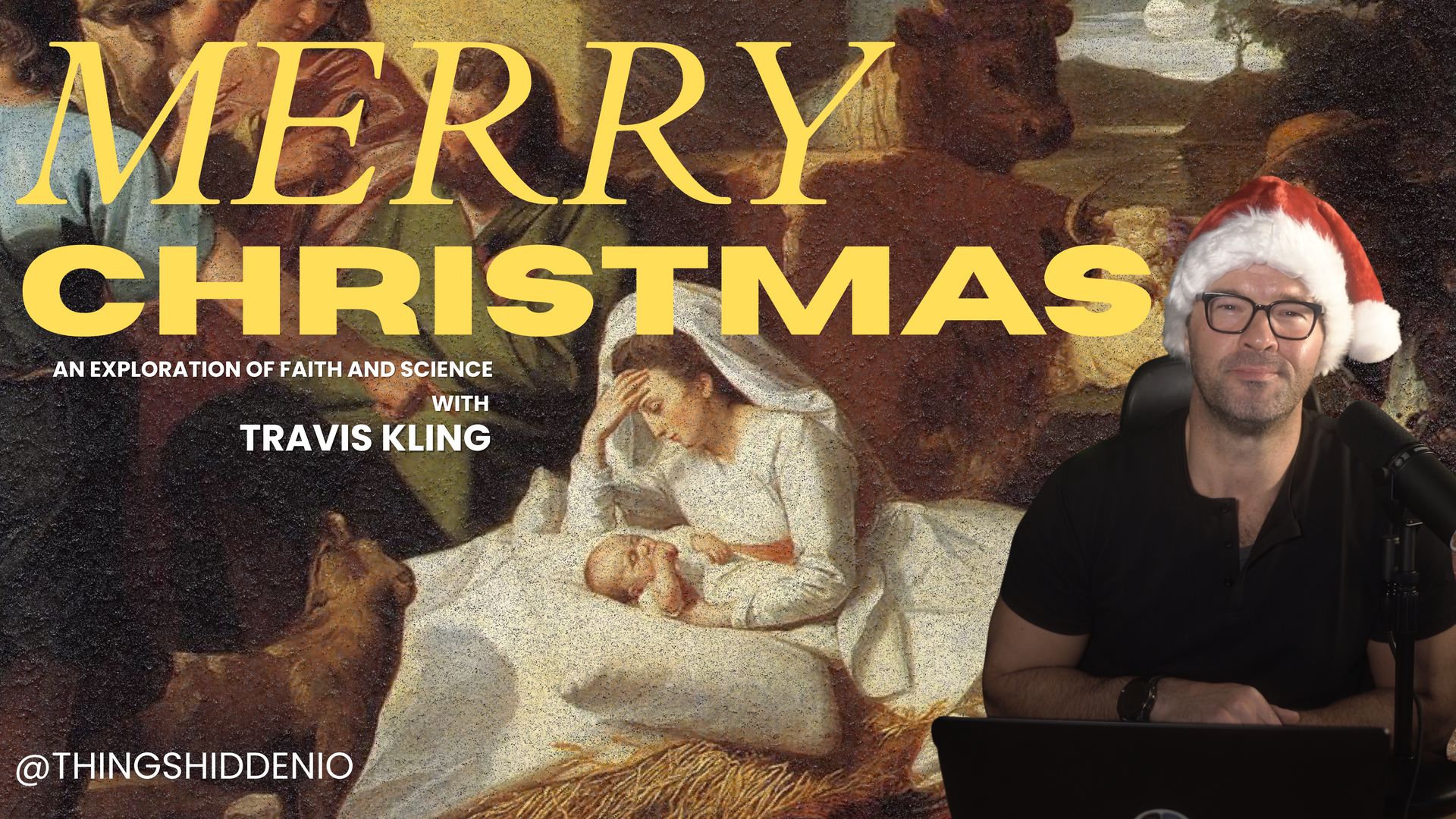
Greetings from Austin! Merry Christmas and happy holidays! I welcome the opportunity to bring to you the Things Hidden Christmas Special.
You can watch the YouTube by clicking the link here-
The script I wrote for this Christmas Special can be found below.
I will give you the TLDR right up front - you can not believe in the virgin birth of Jesus and still think Jesus Christ was a really, really big deal. In fact, you can not believe in the virgin birth and still worship Jesus Christ as Lord and savior. That’s what this episode unpacks.
Please feel free to reach out with any questions or comments you might have. I continue to have phone calls with folks who reached out after watching Things Hidden and wanted to have a discussion about faith. I welcome those discussions, regardless of your vantage point.
If you want to follow along on socials too, they’re all linked here - https://linktr.ee/thingshidden
I hope you have a merry Christmas, happy holidays and a happy new year!
- Travis
τέξεται δὲ υἱὸν καὶ καλέσεις τὸ ὄνομα αὐτοῦ Ἰησοῦν, αὐτὸς γὰρ σώσει τὸν λαὸν αὐτοῦ ἀπὸ τῶν ἁμαρτιῶν αὐτῶν.
τοῦτο δὲ ὅλον γέγονεν ἵνα πληρωθῇ τὸ ῥηθὲν ὑπὸ κυρίου διὰ τοῦ προφήτου λέγοντος ·
Ἰδοὺ ἡ παρθένος ἐν γαστρὶ ἕξει καὶ τέξεται υἱόν, καὶ καλέσουσιν τὸ ὄνομα αὐτοῦ Ἐμμανουήλ · ὅ ἐστιν μεθερμηνευόμενον Μεθ’ ἡμῶν ὁ θεός.
________________________________________________________________________________________________
“She will bear a son, and you shall call his name Jesus, for he will save his people from their sins.”
All this took place to fulfill what the Lord had spoken by the prophet:
“Behold, the virgin shall conceive and bear a son,
and they shall call his name Immanuel”, (which means, God with us).
Matthew 1:21-23 (circa 80-90 AD, in the original Koine Greek and the ESV)
Merry Christmas! I hope you’re having a great end to the year.
I don’t know about you, but 2025 was a big year for me - in part due to the launch of Things Hidden. At this point, Things Hidden has been a 3 ½ year journey for me, but only the last six months of that has been in public. Things Hidden has hugely altered the composition of my faith, and my faith is a big part of my life. So Things Hidden has hugely altered my life.
Talking publicly about faith, about my faith, has been one of the most rewarding experiences of my life. I’m not sure if I would call Things Hidden a career at this point, but I do spend a lot of time on it. So if Things Hidden is allowed to go in the career bucket, it is far and away the most rewarding career experience of my life.
A major reason for that, is the feedback and discussions I’ve been having with people that have been following along with Things Hidden. These have been just tremendously rewarding. I have had people tell me that they have come into a closer relationship with God and Jesus Christ through Things Hidden.
I can’t tell you how humbled I am by that. How grateful I am. I have wept over that. I don’t really have the words to fully explain what an honor and a privilege that is. And I want you to know that I take it incredibly seriously. It is the most serious thing in the world to me and I pray for God’s guidance every day for Things Hidden. And I know that others are praying for Things Hidden too and I feel those prayers.
A separate, but related reason 2025 was such a good year is that I’ve gotten closer to Jesus Christ in 2025. My journey with Things Hidden had periods of time where I had big question marks around the importance of Jesus Christ. I think pretty much anyone that reads enough critical Biblical scholarship gets to that point somewhere along their journey.
The main reason I didn’t start Things Hidden a year earlier was that I didn’t know what God wanted me to say publicly about who Jesus Christ is. Over the back part of 2024 and the first part of 2025, I got more clarity on that, but when I actually sat down to write the scripts for the first 10 episodes of Things Hidden, I still didn’t know exactly what God wanted me to say about Jesus Christ.
But at this point, we’ve talked a lot about Jesus. And when I look back on that body of work, I feel that I said what God wanted me to say (so far). And there is a deep peace and honestly a relief that comes from that. In particular, episodes 3, 4 and 5 stand together as a "non-traditional Christian apologetic” that is sort of my personal pitch for Jesus Christ. And the basics of that was written down in my notes before I wrote the scripts, but actually writing the scripts was still clarifying for me and my faith and I’m very grateful for that.
Additionally, episode 9 on Mimetic Theory was a breakthrough for my faith. The preparation and writing of that episode helped further clarify the importance of Jesus Christ for me. I’ve cried a bunch of times with Things Hidden, but the hardest I’ve cried was when I realized the meaning of Peter’s denial and then his reconciliation with the resurrected Jesus. I had a moment in there where I felt like I got a true glimpse into the nature of God and I just had snot running down my face from that. I want to be very clear, there is a path you can take towards Jesus Christ that is a path made up of Mimetic Theory. And that path can clearly lead you to worshiping Jesus Christ as your Lord and savior. If you missed that part in Episode 9, go back and listen again and then let’s get on the phone and talk about it.
So… I got closer to Jesus in 2025. The Christmas holiday is a celebration of the birth of Jesus. Secular culture tries to separate Christmas away from Jesus. Secular culture wants to downplay Christ in Christmas, or do away with Him entirely. That is the wrong amount of attention to give to Jesus Christ. I am certain of it. That’s true in general but it’s especially true at Christmastime.
Christmas can be a sad time for people for a bunch of reasons. Perhaps you are sad right now reading this. One of the reasons some people are sad at Christmas is they have no relationship with Jesus. They are not spending any time on Jesus. And with Jesus. I bet you could get a big cohort of people that don’t have any relationship with Jesus. And then get a big cohort of people that have a strong relationship with Jesus. And then you could ask each of the cohorts questions about their wellbeing around Christmastime. And I bet the cohort of people that have a relationship with Jesus will have a higher sense of wellbeing around Christmastime. All the stories about Jesus could be made up and there would still be worthwhile reasons to have a closer relationship with Jesus. That’s just something… worth chewing on.
At this time of year, secular culture tries to push you to forget about the importance of Jesus Christ. Do not forget about the importance of Jesus Christ. Jesus Christ is the most important entity in human history. That’s the starting point and then you go from there about the specifics of what exactly that means.
There are many specifics you can get into. Several lifetimes worth of study and you still won’t get all the answers. Even with 10 lifetimes you wouldn’t get all the answers because we are grasping at the ungraspable. The life and teachings of Jesus Christ are closely intertwined with the divine and if you’re talking about the divine; the cosmic metaphysical; the Creator of this universe; you’re never going to totally get it.
But there are many specifics you can get into once you agree Jesus Christ was the most important entity in human history. What does it mean to be the Son of God? What does it mean to be the Son of Man? What does it mean to be the Messiah? What was the resurrection? Did Jesus really do all those miracles? What does Jesus have to do with the eternal fate of my soul? Lots of specifics.
One of those specifics is that Jesus was born of a virgin. I have a question mark around the virgin birth. I’m more comfortable saying “I don’t know about the virgin birth” than saying “I don’t believe in the virgin birth”. And then, importantly, I have gotten comfortable with saying “IDK about the virgin birth” while still worshiping Jesus Christ as Lord and savior. I feel that God has given me “permission” (through prayer and study and contemplation and conversation) to have my faith constructed this way.
The overwhelming majority of Christians affirm a belief in the virgin birth. This is in both the Nicene Creed and the Apostles Creed. There are many Christians that would tell you you’re not a Christian if you don’t believe in the virgin birth. I want to tell you to not be deterred by this. I have prayed a ton about this and I am not deterred by it. You can not believe in the virgin birth and still worship Jesus Christ as Lord and savior and not worry about the eternal fate of your soul. There is a path there. I know because I am on it.
Why would anyone doubt the virgin birth narrative? The most obvious reason is that there has never been a scientifically confirmed case of a virgin giving birth. So that would be, as far as we know, the only time that’s ever happened. That would be a miracle. A miraculous birth.
There have been quite a few stories of miraculous births about very significant historical figures-
Alexander the Great was born in 356BC. Alexander’s mother Olympias was said to have been impregnated by Zeus. His earthly father was Philip II of Macedon.
Augustus Caesar was born in 63BC and died ~19 years before Jesus did. Caesar’s birth was heralded by omens. A star fell from the sun into his lap at birth.
Pythagoras was born in ~570BC. His mother was said to be a virgin impregnated by Apollo. He was born with a golden thigh and spoke prophetic words at birth. His earthly father was Mnesarchus.
Plato was born in ~428BC. His mother was implied to have been a virgin and she was said to have been impregnated by Zeus. His earthly father was Ariston.
So miraculous birth stories for significant figures were something that was in place before Jesus was born.
The four gospels in chronological order are Mark, Matthew, Luke and John. Mark was written in ~65-70AD. Matthew and Luke were written in ~80-90AD. John was written in ~90-100AD. Mark, the earliest gospel, and John, the latest gospel, contain no virgin birth narrative at all. They don’t say anything about Jesus’ birth. Mark also includes an additional conflicting piece to the story. In Mark chapter 3, Jesus has a chaotic crowd of people around him, wanting to hear his teachings. His mother and brothers heard about this, and they go to take charge of him because “He is out of His mind”. If Jesus was born of a virgin, and if angels came to tell Joseph and Mary that their child would be the savior of the world, why would His family be surprised that people are gathering around Him to hear His teachings?
The Gospel of John has a similar conflict - John 7:5 - “For even His brother did not believe Him.” How could Jesus have had a miraculous birth and His brothers not believe in His miraculous works as an adult? So the two gospels that don’t include the virgin birth are the two gospels that have these conflicting accounts of what Jesus’ own family thought about Him. And interestingly, the two gospels that do include the virgin birth, Matthew and Luke, don’t mention these conflicting accounts from the family at all. Hmm… Christian apologists will try and explain why these things are the way they are, despite the virgin birth actually occurring. I do not find these reasons to be compelling.
Additionally, each gospel has its own unique motivations and major points that the author wants to convey. The gospel of Matthew was written to Jews and the main point the author is trying to get across is that Jesus is the new Moses and that Jesus fulfilled Messianic prophecies from Hebrew Scriptures. Matthew makes reference to the virgin birth of Jesus as fulfilling prophecy from the Old Testament book of Isaiah, written some 700 years before the birth of Jesus. The book of Isaiah is written in Hebrew. Matthew is written in Greek and the author was using the Greek translation of the Old Testament for his many references. But when you look at this verse in Isaiah 7:14, the word for “young woman” is mistranslated as “virgin” from Hebrew to Greek. So it appears that the author of Matthew was trying to tie Jesus back to ancient Jewish Messianic prophecies as many ways as he could. And he saw the word for “young woman” mistranslated as “virgin”, and then included the story of the virgin birth of Jesus.
Additionally, Paul wrote seven undisputed books of the New Testament. These were written from the early to late 50’s AD, so a few decades before the virgin birth story first shows up in Matthew. Paul makes no mention of the virgin birth. None at all. Why would Paul make no mention of Jesus being born of a virgin if that was a story that was circulating orally at the time? Christian apologists will try and explain why this would be the case, despite the virgin birth actually occurring. I do not find these reasons to be compelling.
The only two books in the Bible that tell the virgin birth story are Matthew and Luke. There are no other references to it in the New Testament. Matthew and Luke tell the same general story about the virgin birth, but quite a few of the details are quite different. Some of those differences I would consider basically irreconcilable - one or both of the stories are almost certainly not completely literally accurate.
You can read the stories one after the other. It’s the first couple chapters of Matthew and Luke. It will take you 20 minutes to read. You could take notes on what happens in each of the stories and you could compare the two stories and see if there are significant differences.
In the opinion of the majority of New Testament scholars, there are a number of significant differences. I agree with that. These differences exist on a spectrum of “reconcilability”. How many of the differences can you sort of tilt your head and say “ehh, yeah I could see how both of these accounts could still be technically literally true”? And how many are really tough to reconcile and at least one and maybe both gospel accounts are not literally true in that specific instance? Some are more reconcilable than others. You could assign a 1-5 score on these differences based on their reconcilability, with 5 being the most difficult to logically reconcile.
That would look something like this -

The top three with 5 ratings in particular are pretty much irreconcilable to me. And the totality of the differences leads me to believe that it’s pretty much impossible for both gospel accounts to be completely literally true. That means at least one account is at least somewhat not literally true. And that just opens up a whole new way to think about what the Bible is.
You could ask the question -
“If the evidence against the virgin birth is this strong, why do virtually all Christian pastors/preachers/priests/apologists affirm the virgin birth and preach it?”
And that’s a good question. I think many would point to tradition. They would say-
“This virgin birth story was circulating about Jesus within ~50 years of His death and potentially earlier.”
And they would be correct. They would say-
“Many and probably most early Christians believed in the virgin birth.”
And they would be correct. Although we know that not all Christians in the first 300 years after Jesus’ death believed in the virgin birth. The Ebionites, Cerinthians, Marcionites, and various sects of gnosticism, including Docetists, did not believe in the virgin birth. We don’t have a ton of detail about the specifics of these conflicting beliefs about the virgin birth, and there is an aspect of “history is written by the victors” here - the groups that didn’t believe in the virgin birth were deemed heretical, and the large majority of their scriptures and writings were likely destroyed. But there are confirmed accounts of numerous groups of early Christians that did not believe in the virgin birth.
It is easy for me to imagine why the virgin birth story was created, even if it didn’t actually literally happen. The virgin birth story is a transmission mechanism. A very strong transmission mechanism. In a time where literacy rates were less than 10%, the vast majority of information was shared orally. The first written account of the virgin birth occurred ~50 years after Jesus’ death. That is the same amount of time as there is between 1975 and today. And if you want people to remember an oral story, it helps a lot to have some razzle dazzle on it. There is an entire field of study focused on cultures that transmit stories orally, and that field of study consistently finds that stories told orally change over time.
The entire concept of something being “literally, exactly true” means something very different today than it did 2,000 years ago. There basically were not sources of literal, exact truth 2,000 years ago and so that concept was just not something that people back then were focused on or even aware of. Our modern paradigm of being able to prove something that happened to an exacting level of detail was simply not in place 2,000 years ago.
Personally, I do not want to do anything that lessens the transmissibility of the story of Jesus. I have prayed a lot about this with Things Hidden. But we live in 2025 and we are firmly in the midst of The Information Age. Everything I have talked about here today with the virgin birth is very readily available all over YouTube, for free. You can start asking questions about the virgin birth to any LLM and that LLM will start telling you things I have been telling you. This accessibility to Biblical scholarship is a drastic change relative to what has been in place for 99% of the time since Jesus died. And so the idea of the transmissibility of the story of Jesus is a totally different thing today than it ever has been before.
I am not against believing in the virgin birth narrative. That’s not what I’m trying to do because I don’t get the sense that’s what God wants me to do. I am also not personally certain the virgin birth didn’t happen. It absolutely could have happened. I believe in a God that could get that done. But I have a question mark on the virgin birth and my relationship with the Creator of this universe is not predicated on having a firm answer there. And I still worship Jesus Christ as my Lord and savior. There has never been another entity on this planet closer to God than Jesus. That seems very obviously true to me. And I think it’s a good thing to spend lots of time chewing on what exactly that means. And what the specifics might be…but do so knowing that you will never be able to fully comprehend what Jesus’ relationship with God is. That is grasping at the ungraspable and it is a deeply worthwhile pursuit.
So that is my Christmas message. You can not believe in the virgin birth and still worship Jesus Christ as your Lord and savior. You can affirm that the entirety of the human species hinges on this entity called Jesus Christ. You can affirm that His life and teachings are the best thing humanity has ever had to triangulate our actions towards. You can study His life and teachings and you can pray to God to help you implement that morality in your life and the Holy Spirit will come and help you do that. And it will change your life for the better. If that’s not a miracle, I don’t know what is. That’s the Christmas miracle. Two thousand and twenty-five years ago a baby was born and that baby grew up into an entity that gives humanity access to God in a way that nothing else ever has or ever will.
Merry Christmas indeed.